On Loving the Tribe You Would Never Join (If you weren’t already in it)
980 words. ~4 min read.
Okay, this one is weird, but stick with me for 2 minutes; maybe you know what I am talking about: There’s something strange - almost jarring - that happens when I catch a glimpse of a group I belong to. From the outside.
Prime example: Golfers. Specifically the Saturday/Sunday morning foursome kind. There’s the polo shirts, the bad jokes, the banter, the golf gear, the booze. Passing a group like that, I reflexively cringe - until I realize: Wait. I am that guy. (My wife, in her loving way, has no small part in creating that self-awareness for me.)
Or consider the financial services crowd. (Yes, here comes the own-goal.) Polished, precise, prone to using acronyms that no human ever asked for. There’s something about these get-togethers that’s both comforting and absurd. Like a conference room performance of “Wall Street: The Musical”. I’ve spent years in that world, I can sing along to every song. Happily.
So what gives? How can I belong feel at home in groups that, viewed from afar, make me want to cross the street?
Turns out, this is a known phenomenon - the paradox of identity. It’s weird, it’s funny, and it’s probably something you’re doing, too.
The Tribe and The Cringe
Does this sound familiar? You overhear a group chatting in public, and it’s so stereotypical, it’s painful. You roll your eyes, maybe even mutter something under your breath. An hour later, you’re in a different room, saying the same things to people wearing the same uniform - metaphorical or otherwise. Now it’s your tribe, so it feels different, meaningful even.
Golf course groupthink? That’s camaraderie, see here. Excessive acronym use? That’s just efficient alignment of strategic OKRs.
So what’s happening here?
A Little Science: Social Identity Theory (and Practice)
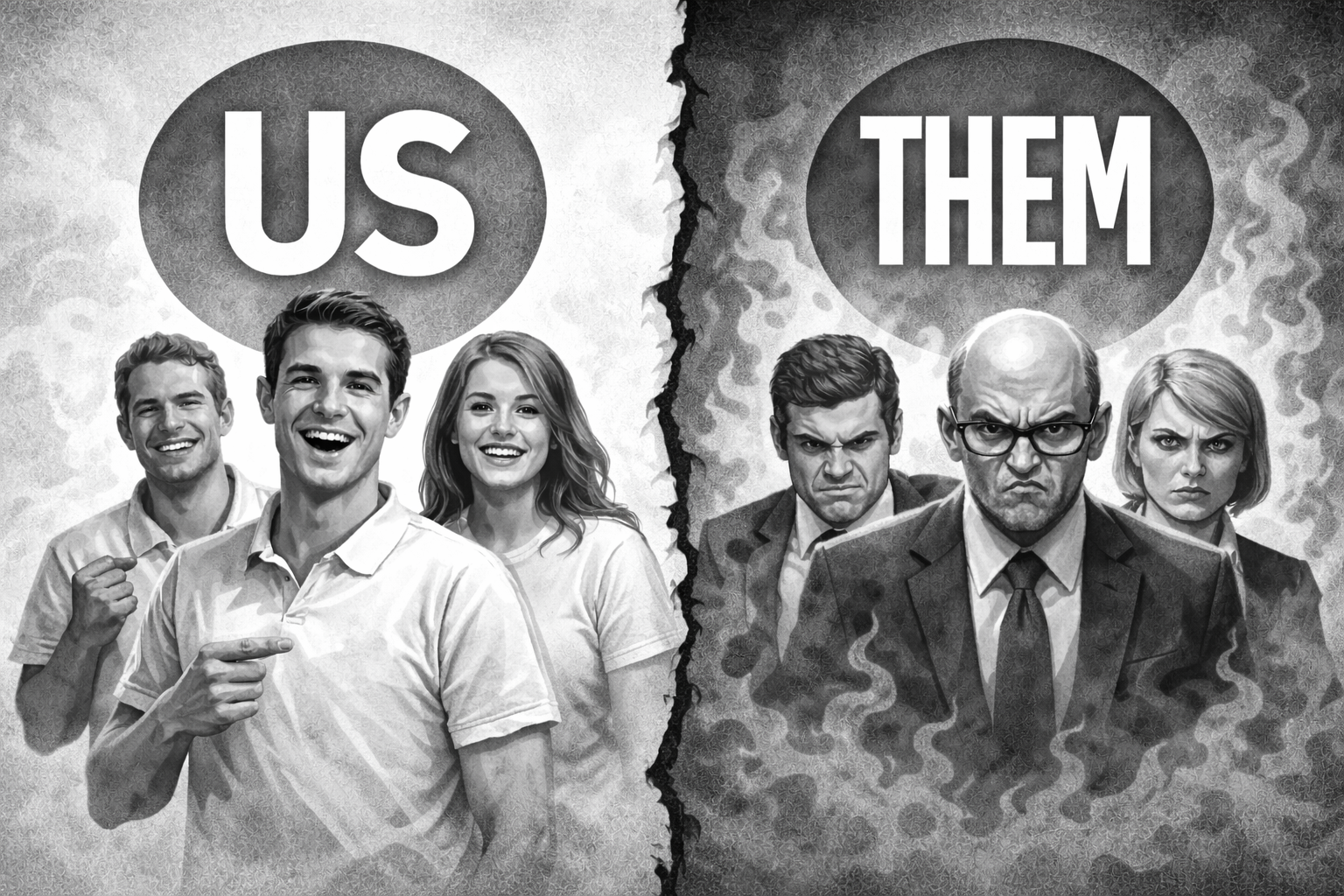
Social Identity Theory - the world in black and white.
Individuals define themselves through group memberships. We kinda know that, but psychologists Henri Tajfel and John Turner developed a whole theory around that. It postulates that we categorize people into groups (“us vs. them”), and our self-concept gets wrapped up in how we see the in-group. Easy enough, but this also makes us prone to:
In-group favoritism. We see our group as more nuanced, well-intentioned, and generally superior.
Out-group bias. We flatten others into caricatures and often perceive them as more extreme, more ridiculous, more them. (Wow, hard to not get political on that note!)
Okay, but this will blow your mind: We apply this flattening even to groups we actually belong to, when we observe them from the outside. Total dissonance, because we see them as “them”, not as “us”.
This is the strange duality of self-awareness: I know I belong, but from the outside, I also know how ridiculous we look and would maybe rather not belong. But I am still happy that I belong. What?
Hypocrite? Human?
This paradox matters. Because it’s not just about golf cliques or finance bros. It’s about every team, every subculture, every “insider” group you think is amazing… and that someone else sees as a joke. Finding comfort in this paradox is quite possibly an underestimated life skill. But for me, I found that it holds a different treasure altogether:
Every once in a while, you meet someone in these groups who’s a complete violation of the stereotype - and it’s glorious. The ultra-low-ego finance leader who hates jargon and just wants to build something meaningful. The golf buddy who quotes Camus and reads putts like a philosopher.
I have found role models in these outliers. They remind us that identity doesn’t have to be one-dimensional. They stretch the boundaries of the tribe from the inside, often with more influence than a thousand DEI slide decks ever could. To this day, I can easily name a dozen folks whose influence on me is outsized, because they chose to define the group vs. having the group define them, all while being highly appreciated members, poster-boys even.
Final Thought: Loving the Tribe you wouldn’t join
There’s a quote - often attributed to Groucho Marx - about not wanting to belong to any club that would have you as a member. Deep stuff. But this is different.
I do want to belong. I just reserve the right to look at my fellow members and say, “God, we’re annoying”. (My wife probably sent me to the golf course with those words).
And then smile.