~1,200 words. 5 minute read.
Every hiring conversation I've been part of this year starts the same way. Somewhere in the first ten minutes, someone leans forward and asks: "But how are they with AI?"
I ask it too. Quick John Madden moment (stating the obvious): In digital product management, AI expertise is not a nice-to-have. It's table stakes. That’s true for other disciplines as well, of course: We don't hire anyone without it. Not product managers, not designers, not analysts, not the person who keeps our backlog honest.
So this isn't a post against AI talent. It's a post about the question we keep forgetting to ask in the second ten minutes.
The gold rush is real
The numbers back up the AI hiring frenzy. Dice looked at seven million U.S. tech job postings and found that AI skills went from appearing in 15% of them in January 2024 to 75% by mid-2026. Three out of four. In two and a half years. (Let me check Kalshi, but I’m sure the odds are that we’re at over 90% at the time of this writing).
And it isn't just engineers. Back in 2024, Microsoft and LinkedIn's Work Trend Index already found that two-thirds of leaders wouldn't hire someone without AI skills, and that 71% would rather take a less experienced candidate with AI skills over a more experienced one without them. The market pays for it, too: Lightcast data shows postings that mention AI skills pay about 28% more than comparable roles that don't.
Good reminder for an Econ major like myself: As always, the market is right. Mostly.
But read that 71% again. Less experienced. Over more experienced… Experience at what, exactly?
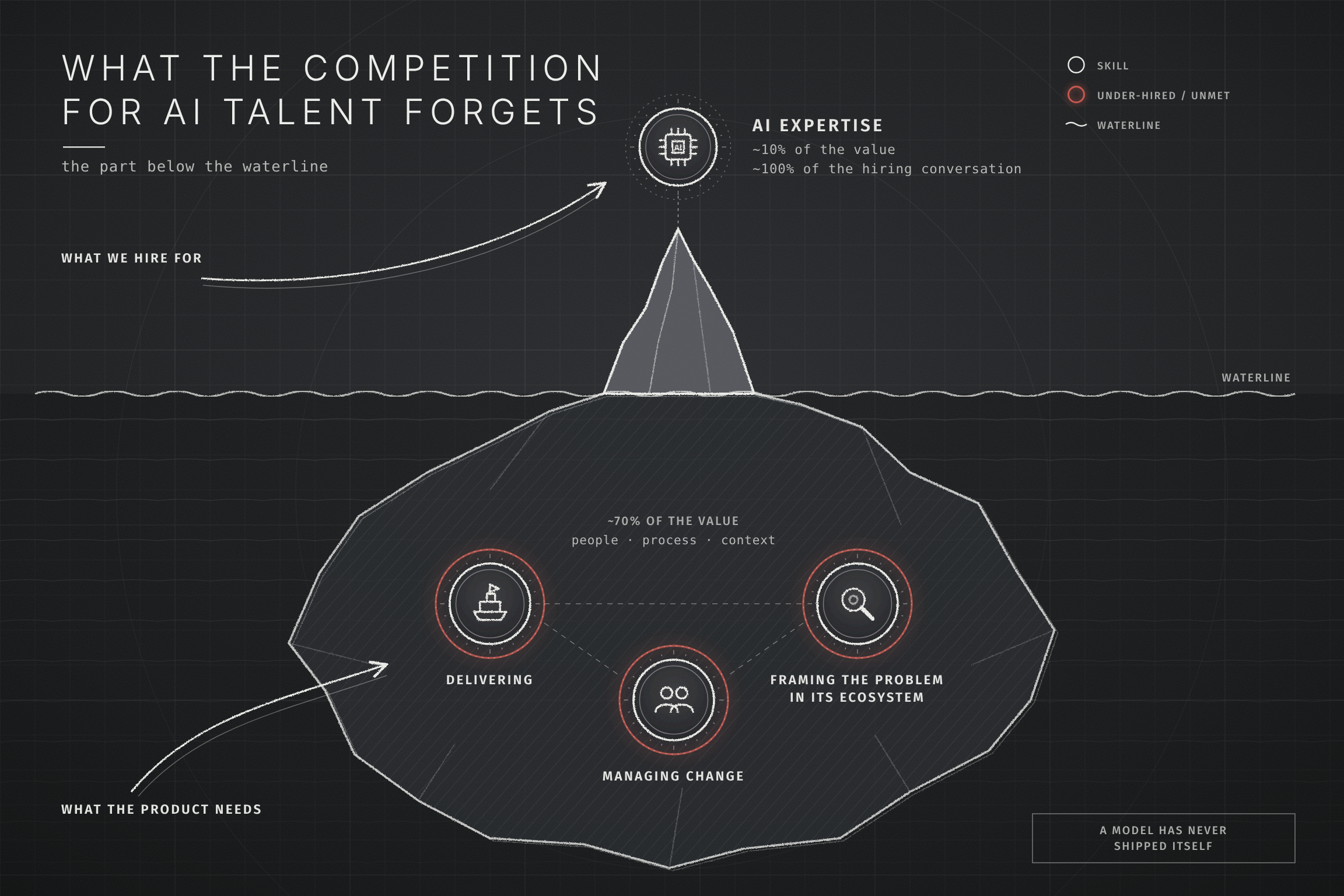
10% of the value, 100% of the conversation?
Meanwhile, back in the real world
Here's the other half of the picture, the one that rarely makes it into the job description (you can always find proof for both sides of an argument - something we tend to forget in times of algorithm-created bubbles):
RAND interviewed 65 experienced data scientists and engineers to understand why AI projects fail, and they fail a lot: by some estimates more than 80% of them, roughly twice the rate of IT projects without AI. The number one root cause wasn't bad models or bad code. It was people misunderstanding, or miscommunicating, what problem actually needed solving. Please read that twice.
MIT's NANDA initiative got to the same place from another direction. In its 2025 study, 95% of enterprise generative AI pilots stalled before scaled adoption, and the lead author put it down to how organizations try to use the technology, not the quality of the models. Gartner expects over 40% of agentic AI projects to be canceled by the end of 2027, citing rising costs, unclear business value and weak risk controls. Ouch.
And the people who do get value? McKinsey's latest survey finds that only 37% of companies report any EBIT impact from AI at all, a share that hasn't moved in a year. Its 2025 edition found that deliberately redesigning workflows was one of the strongest drivers of real business impact. BCG has been saying something similar for years with its 10-20-70 rule: about 10% of AI's value comes from the algorithms, 20% from data and technology, and 70% from people and processes.
Difficult sentence, difficult truth: The model is the easy part.
The 70% nobody puts in the job description
The 70% then comes from three things a product person has to be able to do. None of them are new. All of them have become more important, not less.
1. Delivering
A demo is not a product. A pilot is not a product. A beautifully prompted agent in a sandbox is a very convincing proof of concept, and that's where most of them stay.
Delivery is the unglamorous craft of getting from "look what it can do" to "it's running, it's supported, and people pay for it." It means slicing scope, deciding what you won't build, getting through security and legal review, planning for the moment the model gets something wrong, and owning the outcome after launch. That is the difference between the 95% that stall and the 5% that don't.
If you can build an impressive agent but you've never pushed anything through to production, you haven't done the job yet. You've done the fun part.
2. Managing change
Here's the thing about AI products: they almost always change how someone works. The support agent who now reviews drafts instead of writing replies. The analyst who now checks a model's forecast instead of building one. The sales team whose CRM suddenly has opinions.
If those people don't adopt it, you shipped nothing. Spoiler alert: they won't adopt it just because it's clever. (Another sentence worth reading twice). They'll adopt it when someone has understood their day, involved them early, explained what changes and what doesn't, and stuck around long enough to fix what broke. You know - like a Product Manager, maybe.
McKinsey's finding about workflow redesign is really a finding about change. The workflow is the product.
3. Framing the problem in its ecosystem
This is the one I care about most, and the one RAND puts at the top of its list. Before anyone touches a model, someone has to work out what the real problem is. Not the symptom. Not the problem the steering committee wants to hear about. The real one.
And then, harder still, they have to see where it sits. Every product lives inside an ecosystem: upstream data nobody owns, downstream processes that depend on today's quirks, three other teams with roadmaps of their own, a compliance function, and a customer journey that doesn't care about your org chart. (It’s hard enough to care about org charts anyways, ya?)
Picture an agent that halves the time it takes to process a claim, and in doing so floods the fraud team with edge cases, breaks a reporting pipeline in finance and surprises a customer with a decision nobody can explain. Locally brilliant. Systemically useless. (When my son was 10, I asked him what ‘Wisdom’ was. His answer: “Wisdom is quotes.” This is a very quotable blog post, so… lots of wisdom in here.)
The person who sees that coming before it ships is worth more to me than the person who can fine-tune the model. Ideally, of course, it's the same person.
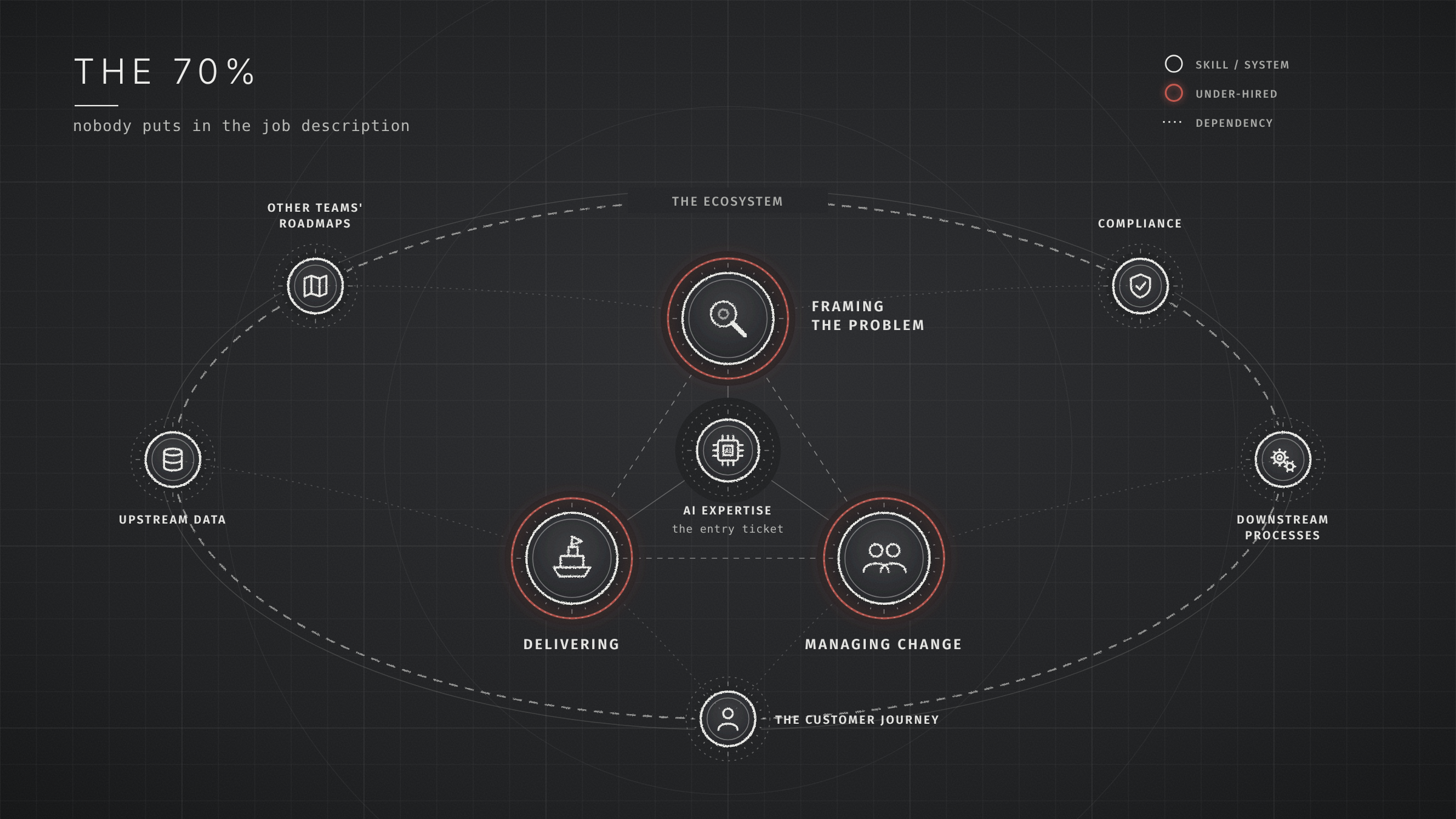
All of them have become more important, not less.
What this asks of us
If you're hiring: keep the AI bar. Raise it, even. But spend the second ten minutes on the 70%. Ask about something they shipped that people actually changed their behavior for. Ask what broke downstream, and how they found out. Ask about a problem they turned down because it was the wrong one to solve.
If you're the one being hired: your AI skills get you into the room. They don't get you the seat. The seat goes to the person who can take a clever idea and land it in a messy organization, with real people and real constraints, without breaking three other things on the way.
And if you're the organization: stop treating AI talent and product talent as two different hires. They aren't. They never were. (Neither are the products in your backlog).
The competition for AI talent is real. But the people who win it won't be the ones who know the most about models.
They'll be the ones who know what to do with them.